 Cookies
We need your consent to use the individual data so that you can see information about your interests, among other things. Click "OK" to give your consent.
ASTM D4879-02
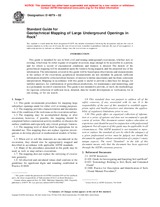
Standard Guide for Geotechnical Mapping of Large Underground Openings in Rock
STANDARD published on 10.7.2002
The information about the standard:
Designation standards: ASTM D4879-02
Note: WITHDRAWN
Publication date standards: 10.7.2002
SKU: NS-28996
The number of pages: 12
Approximate weight : 36 g (0.08 lbs)
Country: American technical standard
Category: Technical standards ASTM
Annotation of standard text ASTM D4879-02 :
Keywords:
cavern design, civil underground excavations, cleavage planes, discontinuities, excavation site, face, fault zones, geotechnical mapping, mapping, mines, rock, rock mass response mapping, subsurface openings, surface analysis, underground environments, underground excavations (civil/mining), ICS Number Code 07.040 (Astronomy. Geodesy. Geography)
Additional information
| 1. Scope | ||||||||||||
|
1.1 This guide recommends procedures for mapping large subsurface openings made for either civil or mining purposes. 1.2 The mapping provides characterization and documentation of the condition of the rock mass at the excavation surface. 1.3 The mapping may be accomplished during or after excavation; however, if possible, the mapping should be completed before construction activity modifies or obscures the surface condition and especially any critical geologic features. 1.4 The mapping level of detail shall be appropriate for its intended use. This mapping does not replace rigorous investigations to develop physical or mathematical models of behavior. 1.5 When soil or soil-like materials are encountered in the excavation, they should also be appropriately mapped and described in accordance with applicable ASTM standards. 1.6 Many of the procedures presented in this guide may be used, as well, to map surface excavations. 1.7 The mapping does not replace the surveying of excavation geometry. 1.8 All observed and calculated values shall conform to the guidelines for significant digits and rounding established in Practice D 6026 1.9 This standard does not purport to address all of the safety concerns, if any, associated with its use. It is the responsibility of the user of this standard to establish appropriate safety and health practices and determine the applicability of regulatory limitations prior to use. 1.10 This guide offers an organized collection of information or a series of options and does not recommend a specific course of action. This document cannot replace education or experience and should be used in conjunction with professional judgment. Not all aspects of this guide may be applicable in all circumstances. This ASTM standard is not intended to represent or replace the standard of care by which the adequacy of a given professional service must be judged, nor should this document be applied without consideration of a project's many unique aspects. The word "Standard" in the title of this document means only that the document has been approved through the ASTM consensus process. |
||||||||||||
| 2. Referenced Documents | ||||||||||||
|
We recommend:

Technical standards updating
Do you want to make sure you use only the valid technical standards?
We can offer you a solution which will provide you a monthly overview concerning the updating of standards which you use.
Would you like to know more? Look at this page.