 Cookies
We need your consent to use the individual data so that you can see information about your interests, among other things. Click "OK" to give your consent.
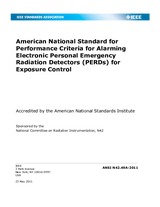

IEEE N42.49A-2011
American National Standard for Performance Criteria for Alarming Electronic Personal Emergency Radiation Detectors (PERDs) for Exposure Control
STANDARD published on 23.5.2011
The information about the standard:
Designation standards: IEEE N42.49A-2011
Publication date standards: 23.5.2011
SKU: NS-417697
The number of pages: 54
Approximate weight : 162 g (0.36 lbs)
Country: International technical standard
Category: Technical standards IEEE
Annotation of standard text IEEE N42.49A-2011 :
- Active.
This standard establishes minimum performance criteria and test requirements for four categories of alarming electronic radiation detectors used to manage exposure by alerting the emergency responders when they are exposed to photon radiation. The instruments provide rapid and clear indication of the level of radiation exposure and/or exposure rate and readily recognizable alarms. The alarms are both audible and visual, and distinguishable between
exposure rate and exposure.
ISBN: 978-0-7381-6649-0, 978-0-7381-6650-6
Number of Pages: 54
Product Code: STD97143, STDPD97143
Keywords: alarming detectors, ANSI N42.49A, design criteria, exposure, exposure rate, performance specifications, pocket-sized, personal radiation detectors, photon radiation, radiation detection
Category: Radiation Effects
We recommend:

Technical standards updating
Do you want to make sure you use only the valid technical standards?
We can offer you a solution which will provide you a monthly overview concerning the updating of standards which you use.
Would you like to know more? Look at this page.