 Cookies
We need your consent to use the individual data so that you can see information about your interests, among other things. Click "OK" to give your consent.
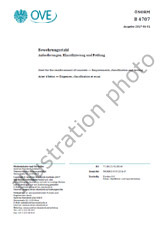

ÖVE IEC 62153-4-10
Metallic communication cable test methods -- Part 4-10: Electromagnetic compatibility (EMC) ż Transfer impedance and screening attenuation of feed-throughs and electromagnetic gaskets - Double coaxial test method ( IEC 62153-4-10:2015) (german version)
Translate name
STANDARD published on 1.8.2026
The information about the standard:
Designation standards: ÖVE IEC 62153-4-10
Publication date standards: 1.8.2026
SKU: NS-1279345
The number of pages: 34
Approximate weight : 102 g (0.22 lbs)
Country: Austrian technische Norm
Category: Technical standards ÖNORM
The category - similar standards:
Annotation of standard text ÖVE IEC 62153-4-10 :
Dieser Teil von IEC 62153 beschreibt ein Doppelkoaxialverfahren, welches geeignet ist, den Kopplungswiderstand und/oder die Schirmdämpfung von Durchführungen und elektromagnetischen Dichtungen zu bestimmen. Das geschirmte Prüfverfahren zur Messung der Schirmdämpfung nach IEC 62153-4-4 (Triaxialverfahren) wurde erweitert, indem die Besonderheiten von Durchführungen und elektromagnetischen Dichtungen in Betracht gezogen wurden. Ein weiter Dynamik- und Frequenzbereich steht für die Messung sogar von hochgeschirmten Durchführungen und elektromagnetischen Dichtungen mit genormter Messausrüstung zur Verfügung; von tiefen Frequenzen bis zur festgelegten Grenze transversaler Wellen in koaxialen Kreisen bei ca. 4 GHz.
We recommend:
Updating of laws
Do you want to be sure about the validity of used regulations?
We offer you a solution so that you could use valid and updated legislative regulations.
Would you like to get more information? Look at this page.