 Cookies
We need your consent to use the individual data so that you can see information about your interests, among other things. Click "OK" to give your consent.
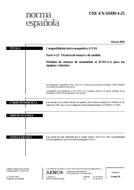

UNE-EN 61000-4-25:2003
Electromagnetic compatibility (EMC) -- Part 4-25: Testing and measurement techniques - HEMP immunity test methods for equipment and systems.
Automatically translated name:
ELECTROMAGNETIC COMPATIBILITY (EMC) -- PART 4-25: TESTING AND MEASUREMENT TECHNIQUES - HEMP IMMUNITY TEST METHODS FOR EQUIPMENT AND SYSTEMS.
STANDARD published on 28.3.2003
The information about the standard:
Designation standards: UNE-EN 61000-4-25:2003
Publication date standards: 28.3.2003
SKU: NS-561417
The number of pages: 54
Approximate weight : 162 g (0.36 lbs)
Country: Spanish technical standard
Category: Technical standards UNE
The category - similar standards:
These changes apply to this standard:
UNE-EN 61000-4-25:2003/A1:2012
Change
Show all technical information.
Electromagnetic compatibility (EMC) - Part 4-25: Testing and measurement techniques - HEMP immunity test methods for equipment and systems
Change published on 18.7.2012
Selected format:Show all technical information.
UNE-EN 61000-4-25:2003/A2:2020
Change
Show all technical information.
Electromagnetic compatibility (EMC) - Part 4-25: Testing and measurement techniques - HEMP immunity test methods for equipment and systems
Change published on 25.11.2020
Selected format:Show all technical information.
We recommend:

Technical standards updating
Do you want to make sure you use only the valid technical standards?
We can offer you a solution which will provide you a monthly overview concerning the updating of standards which you use.
Would you like to know more? Look at this page.